You are currently viewing this website through Internet Explorer. Internet Explorer is an outdated browser.

Please upgrade yourself (by downloading chrome or safari ) and then come back to this website for full viewing capacity.

Thanks!

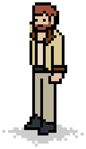
A Young White Clerk

Worked at Sam Houston's Trading Post

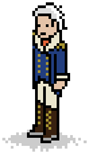
Sam Houston

1st President of Texas

Story from Marquis James' biography of Sam Houston, "The Raven".

Red Book

During the year of 1831 Sam Houston was living among the Cherokee Indians, and he spent most of that time under the influence. The Cherokees conferred a new name on their white counselor - Oo-tse-tee Ar-dee-tah-skee, which means Big Drunk. When Big Drunk was in character a retinue of loyal Cherokees would follow him about to forestall complications, but not always with success. A young white clerk at Houston's trading post displeased his employer and was challenged to a duel. Friends of Houston protested that the clerk's social station precluded him from participation in an affair of honor.

"I've always treated him as a gentleman," roared Houston, "and I'll treat him as a gentleman now."

This improved the morale of the clerk. He was ready to fight.

The meeting took place, and at the count both parties fired. Neither was hit, and seconds intervening persuaded challenger and challenged that honor had been vindicated. But Houston did not learn for some time afterward, if ever, that neither weapon was charged with ball ammunition.

Andrew Jackson

7th President of the United States

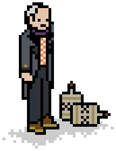
Charles Dickinson

A horse-racer from Nashville

Story from Jon Meacham's biography of Andrew Jackson, "American Lion".

Red Book

In 1806, in an argument over a horse race - the dispute also apparently included a slur against Rachel (Jackson's wife) - degenerated into a duel between Jackson and a man in Nashville named Charles Dickinson. Jackson was determined to have satisfaction, waving off reports that Dickinson might leave the city before the showdown. "It will be in vain, for I'll follow him over land and sea," Jackson said.

At seven o' clock on the morning of Friday, May 30, 1806, on the Red River in Logan County, Kentucky, Jackson and Dickinson faced each other at twenty-four feet. Jackson let Dickinson shoot first, and he hit Jackson in the chest with a bullet. Though wounded, Jackson coolly leveled his own pistol at his opponent, and fired. The Trigger caught halfway; Jackson cocked the gun again and fired, killing Dickinson. Only later, as his boot filled with blood after he had left the dueling ground, did the extent of Jackson's wound become clear. He carried Dickinson's bullet in his body until he died. Even in pain - the wound complicated his health for decades - Jackson never let his mask drop. "If he had shot me through the brain, sir" Jackson told a friend, "I should still have killed him."

Abraham Lincoln

16th President of the United States

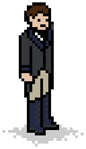
James Shields

United States Senator

Story found on a blog called 'Failed Success'.

Red Book

Since Lincoln was the one challenged to the duel, tradition gave him the privilege of choosing the time and location of the duel, as well as the weapons that were to be used. Being a man of humor and wit, and having no desire to kill Shields, or allow himself to be killed; Lincoln put together the most ridiculous set of circumstances that he could think of regarding the logistics of the upcoming duel.

Lincoln stated that the weapons he wished to use would be “Cavalry Broadswords of the largest size”. He figured that he could easily disarm Shields using the swords, whereas pistols would most likely lead to one of their deaths, if not both. He also added that he wanted the duel to be carried out in a pit 10 feet wide by 12 feet deep with a large wooden plank dividing the square in which no man was allowed to step foot over. These “conditions” were designed not only to be ridiculous; but also to give Lincoln, who at 6’ 4” had longer legs and arms and towered over the much smaller Shields, a decided advantage.

Before the duel, Lincoln demonstrated his obvious physical advantage by hacking away at some of the branches of a nearby Willow tree. The branches were high off the ground and Shields could not hope to reach them; while Lincoln, with his long arms holding a long broadsword, could reach them with ease. This final display was enough to drive home the precarious situation that he was now in, and Shields agreed to settle their differences in a more peaceful way.

Alexander Hamilton

1st US Secretary of the Treasury

Aaron Burr

3rd Vice-President of the US

Story from a description written by the two seconds after the duel and by Hamilton's physician, Dr. Hosack.

Red Book

"He then asked if they were prepared; being answered in the affirmative, he gave the word present, as had been agreed on, and both parties presented and fired in succession. The fire of Colonel Burr took effect, and General Hamilton almost instantly fell. Colonel Burr advanced toward General Hamilton with a manner and gesture that appeared to General Hamilton's friend to be expressive of regret; but, without speaking, turned about and withdrew. No further communication took place between the principals, and the barge that carried Colonel Burr immediately returned to the city. We conceive it proper to add, that the conduct of the parties in this interview was perfectly proper, as suited the occasion."

"When called to him upon his receiving the fatal wound, I found him half sitting on the ground, supported in the arms of Mr. Pendleton. His countenance of death I shall never forget. He had at that instant just strength to say, 'This is a mortal wound, doctor;' when he sunk away, and became to all appearance lifeless. Some imperfect efforts to breathe were for the first time manifest. Soon after recovering his sight, he happened to cast his eye upon the case of pistols, and observing the one that he had had in his hand lying on the outside, he said, "Take care of that pistol; it is undischarged, and still cocked; it may go off and do harm. Pendleton knows " (attempting to turn his head towards him) 'that I did not intend to fire at him.' 'Yes,' said Mr. Pendleton, understanding his wish, 'I have already made Dr. Hosack acquainted with your determination as to that' He then closed his eyes and remained calm, without any disposition to speak."

Mark Twain

Author & Humorist

James Laird

Paper publisher from Nevada

Story from Mark Twain's abettor and second, Steve Gillis.

Red Book

Those were the days when almost every man in Virginia City had fought with pistols either impromptu or premeditated duels. I had been in several, but then mine didn't count. Most of them were of the impromptu kind. Mark hadn't had any yet, and we thought it about time that his baptism took place.

Of course I was selected as Mark's second, and at daybreak I had him up and out for some lessons in pistol practice before meeting Laird. I set up a board for him to shoot at and Mark would step out, raise that big pistol, and when I would count three he would shut his eyes and pull the trigger. Of course he didn't hit anything; he did not come anywhere near hitting anything. Just then we heard somebody shooting over in the next ravine. Sam said:

"What's that, Steve?"

"Why," I said, "that's Laud. His seconds are practising him over there."

It didn't make my principal any more cheerful to hear that pistol go off every few seconds over there. Just then I saw a little mud-hen light on some sage-brush about thirty yards away.

"Mark," I said, "let me have that pistol. I'll show you how to shoot."

He handed it to me, and I let go at the bird and shot its head off, clean. About that time Laird and his second came over the ridge to meet us. I saw them coming and handed Mark back the pistol. We were looking at the bird when they came up.

"Who did that?" asked Laird's second.

"Sam," I said.

"How far off was it?"

"Oh, about thirty yards."

"Can he do it again?"

"Of course," I said; "every time. He could do it twice that far."

Laud's second turned to his principal.

"Laird," he said, "you don't want to fight that man. It's just like suicide. You'd better settle this thing, now."

So there was a settlement. Laird took back all he had said; Mark said he really had nothing against Laird-the discussion had been purely journalistic and did not need to be settled in blood. He said that both he and Laird were probably the victims of their friends. I remember one of the things Laird said when his second told him he had better not fight.

"Fight! Hell, no! I am not going to be murdered by that damned desperado."